During the National Day holiday, instead of heading to crowded tourist spots, I turned into an ancient city in Xunxian, Henan.
The city is not large, nor is it noisy. It hasn’t been turned into a neatly uniformed “imitation ancient street.” Instead, it exists in a half-worn state, still going about its daily life. Walking in feels like opening an old book that was never closed.

On the way in, I first came across a flowerbed arranged for National Day. Red and yellow chrysanthemums spread out in a carpet, with cartoon figures standing among the flowers. The festivity was genuine, but it also made me realize: this city is being seen in a new way.

A little further ahead, the city gate tower stands. Gray bricks, red columns, flying eaves, a triple-eaved hip-and-gable roof, and a stone plaque above the arch. This is the typical look of a northern ancient city — not showy, but standing firm.
Xunxian has a deeper history than many people realize. It was called Liyang in ancient times, established as Liyang County in the Western Han dynasty, and renamed Xunxian in the Ming dynasty. It was an important node on the Yongji Canal of the Grand Canal. During the Sui and Tang dynasties, grain and merchants traveling north and south passed through here. Dynasties rose and fell, and what remains has accumulated layer upon layer. Exactly which dynasty built the gate in front of me no longer matters much. What matters is that it is still here, still being walked through.

Walking along the city wall, you can see the moat. The water is calm, reflecting the blue sky and the tower.
The moat was standard equipment for ancient Chinese cities. It served both as a defense and as a boundary for daily life. The distinction between “cheng” (inner city) and “guo” (outer city), and the pairing of “chi” (moat) and “cheng,” all come from this layout. In peacetime, the moat no longer defends against enemies, but it remains the line between inside and outside the city. Xunxian’s moat connects to the Grand Canal — the water is alive, and so is the city.
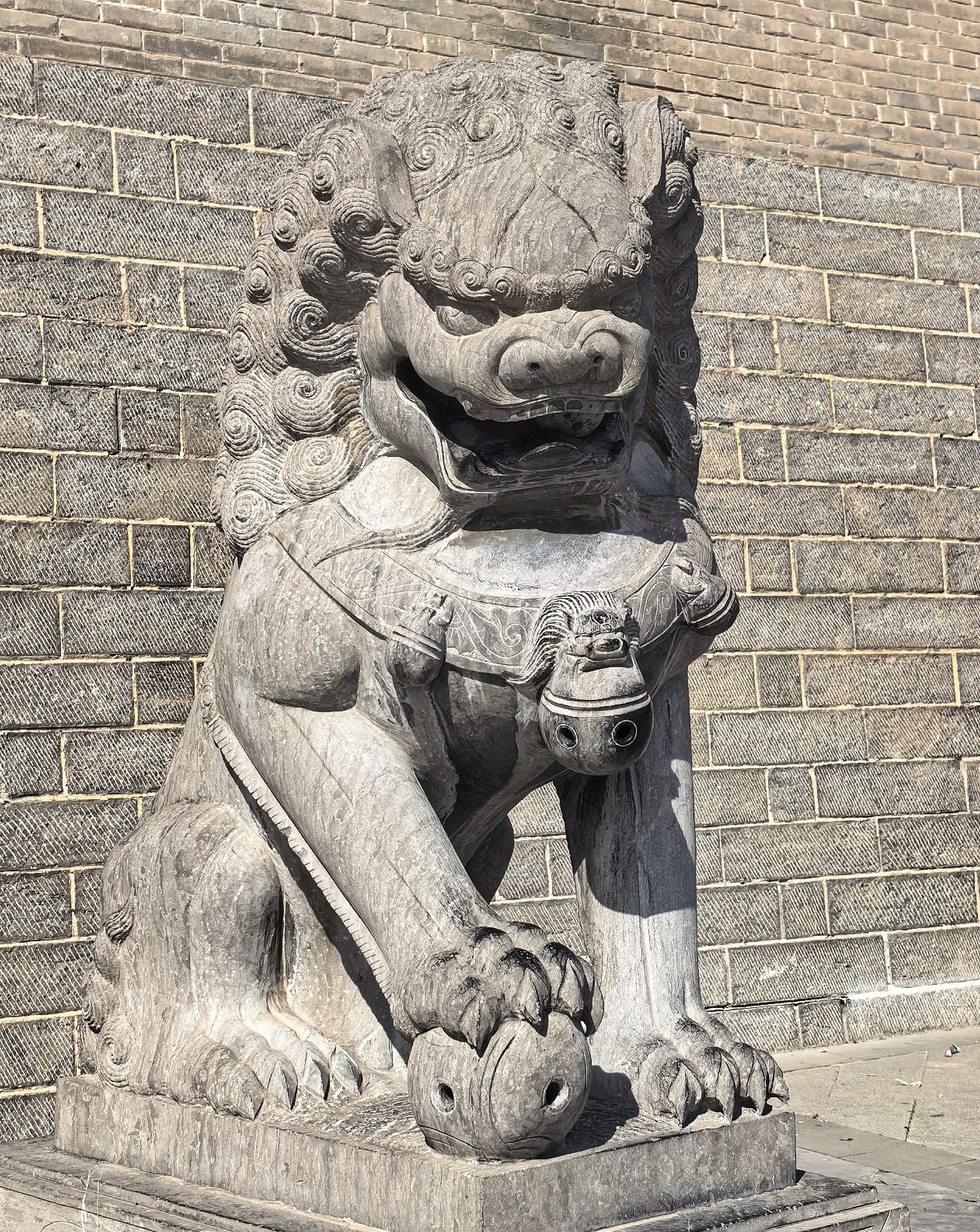
The stone lion at the gate sits beneath the brick wall. Its mane is carved in spirals, its paw rests on an embroidered ball, and the patterns on its body have been worn soft by wind and rain.
Stone lions guarding gates are a Chinese architectural tradition. But each lion’s appearance carries the aesthetics and craftsmanship of its era. This one is not ornate — its lines are simple and honest, as if it were earnestly guarding something.
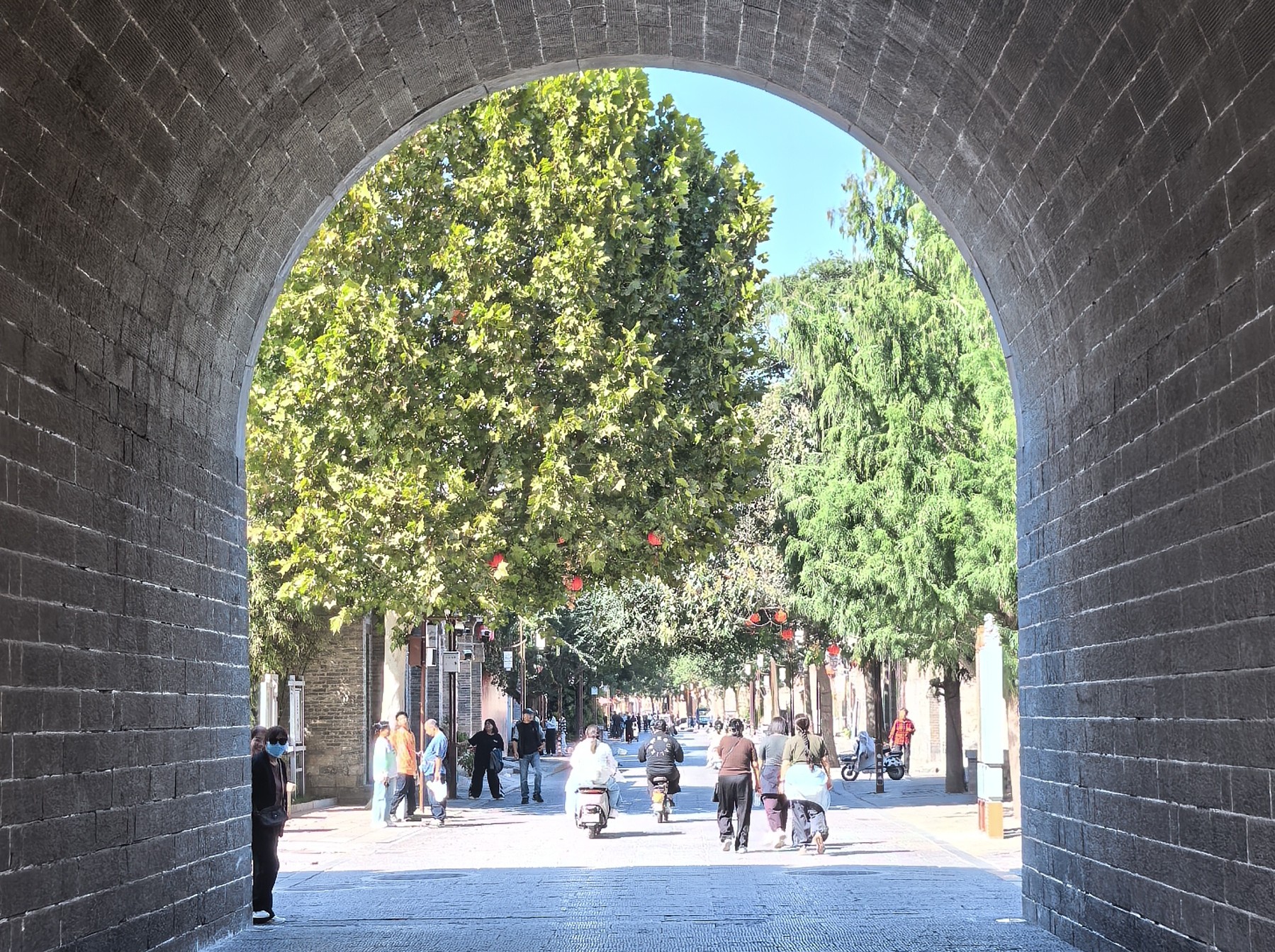
Stepping into the archway, the light dims, then brightens again at the other end. The brick vault narrows layer by layer, framing the distant street, green trees, and passersby into a painting.
The design of such archways is interesting. It’s not just a passage — it’s more like a “transitional space.” As you come in from outside, light, temperature, and sound all change, and your body knows first: “We’re entering the city.”
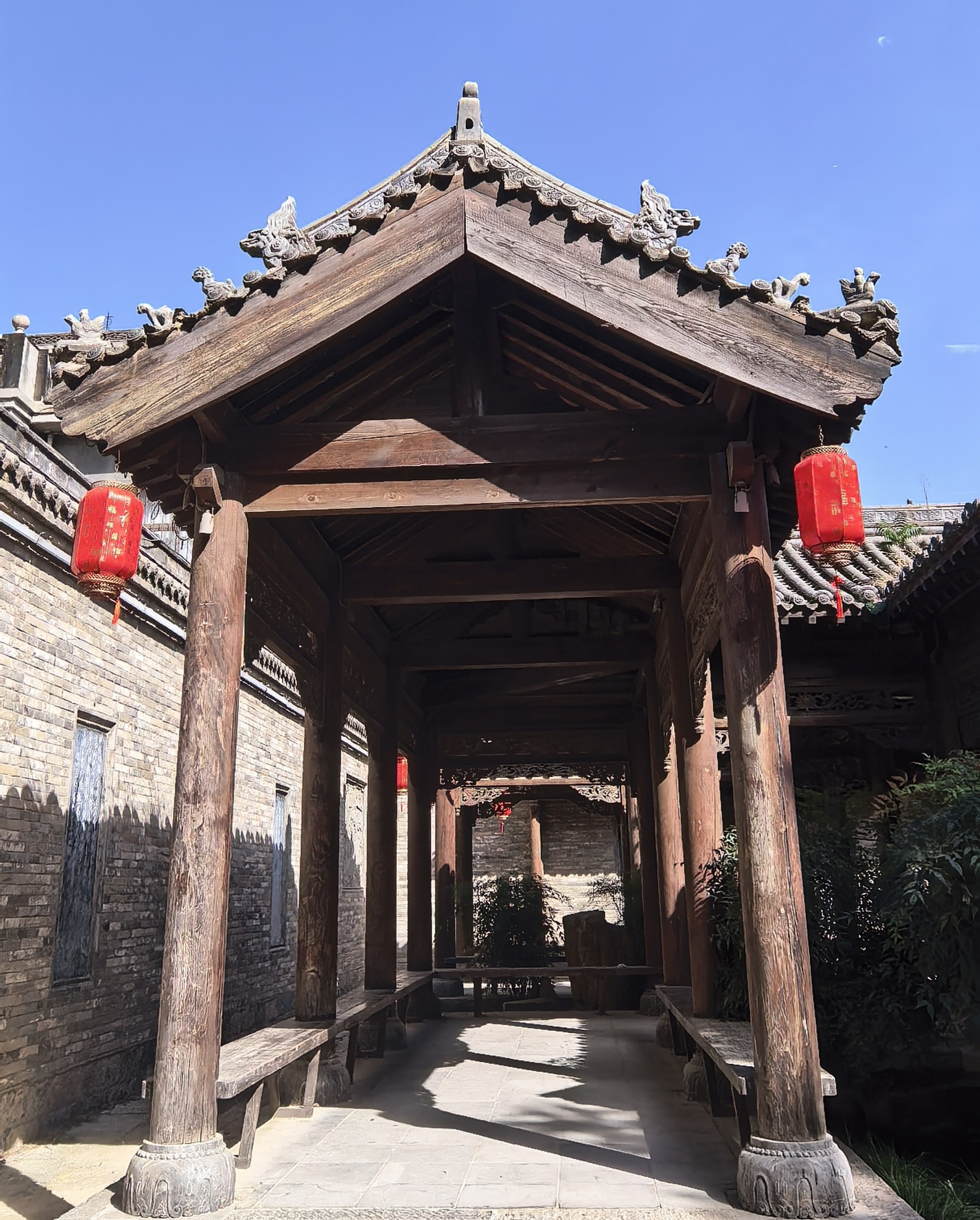
Further in, there’s a wooden corridor pavilion. Thick wooden columns stand on stone bases, gray tiles cover the roof, and red lanterns hang under the eaves. Sunlight filters through the tree gaps, falling on the ground in patches.
The paint on the columns has faded, revealing the wood’s own grain and cracks. This kind of “old” is not decay — it’s a trace left by time. Newly built imitation-antique structures rarely have this feeling.
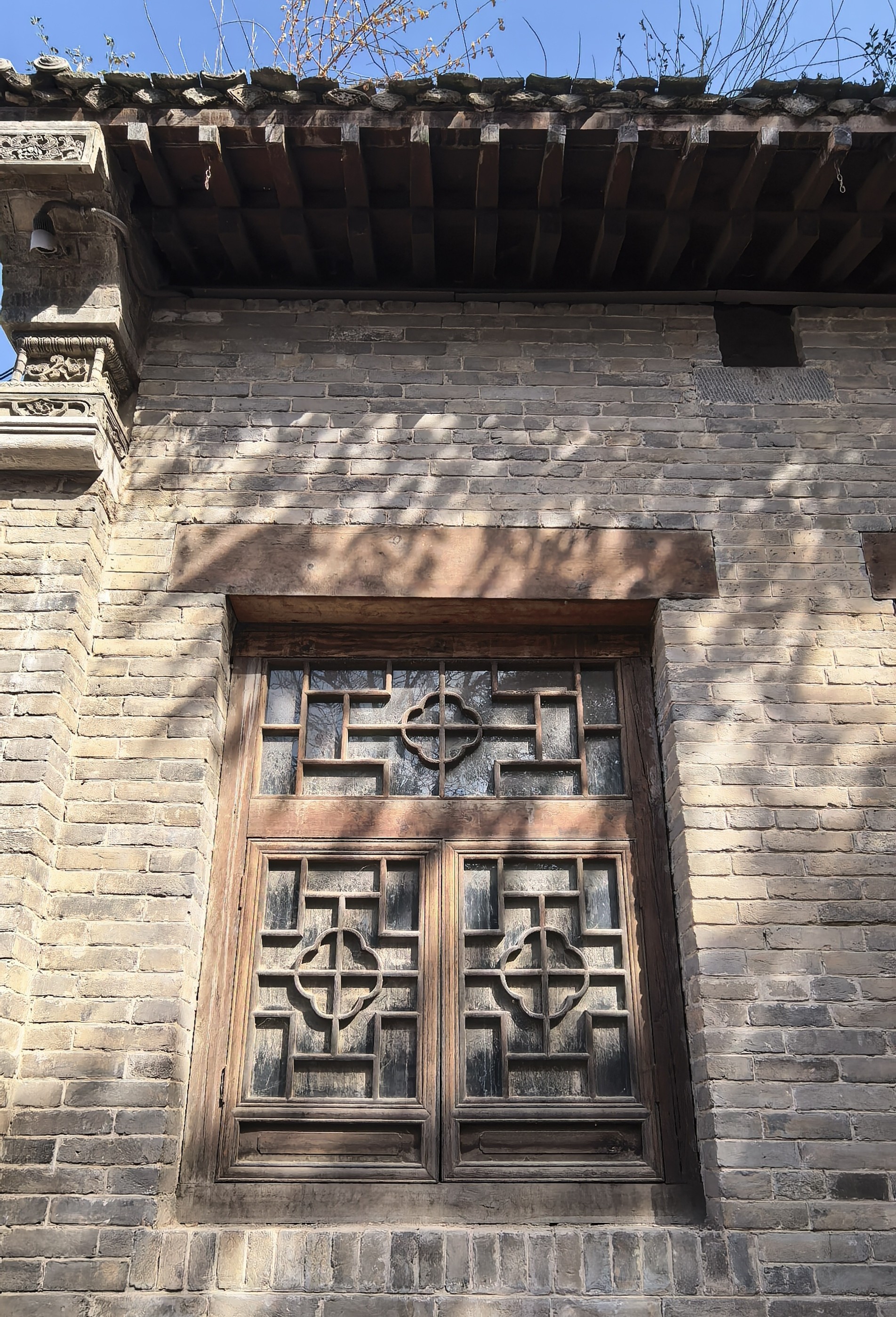
There is a wooden window on the wall. The lattice forms geometric patterns, with a cross in the center unfolding symmetrically. Below is a stone wall base, above are gray bricks, and a few dry plants grow from the cracks.
This kind of lattice window is common in northern dwellings. It’s not only for light but also for decoration. Chinese craftsmanship values the union of “work” and “meaning.” Beyond practicality, it must be beautiful, and it must have thought behind it.
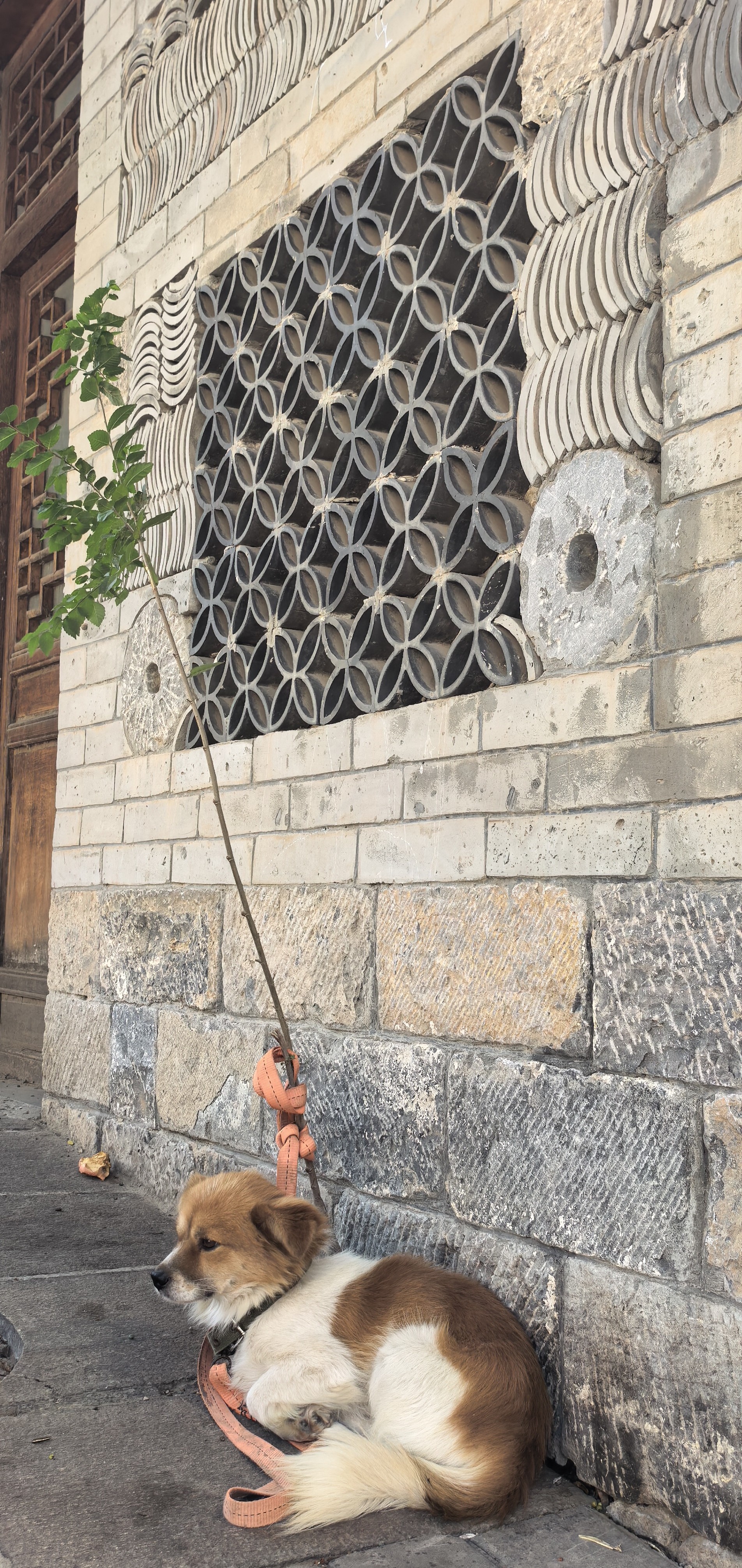
Further in, there is a brick screen wall and decorative wall. Tiles are arranged into diamond patterns, row upon row, like ripples on water. An old millstone is set into the wall beside it.
Brick carving is one of the treasures of northern architecture. It needs no paint — the arrangement of bricks and the depth of carving alone create layers and light. This beauty is quiet; you have to walk closer to see it.

Walking along, I saw a small dog tied to the base of a wall, napping. Its fur was yellow and white, it lay on the ground with its tail curled. Beside it was a thin sapling growing from a crack in the wall.
This scene made me stop for a long time. It was too ordinary. This ancient city is not just for tourists — it is still being lived in by people, animals, and plants. This kind of “living old” is more moving than any restored artifact.

Up close, the brick carvings on the wall are rich in detail. Tiles are laid in wave patterns, with diamond-shaped openwork lattices in between. Different shapes of bricks are combined into ordered patterns.
Ancient builders had a “grammar” for architecture. What brick goes where, what pattern pairs with what function — all had rules. This sense of order is why traditional architecture remains pleasing to look at.
An old wooden door, with a brick frame and wooden panels. Above the lintel, in the brick wall, tile decorations are embedded. The wooden lattice has faded to white; the brass door ring has rusted.
The door is closed. I don’t know what’s behind it. But it already tells a story — about time, about use, about generations passing in and out.

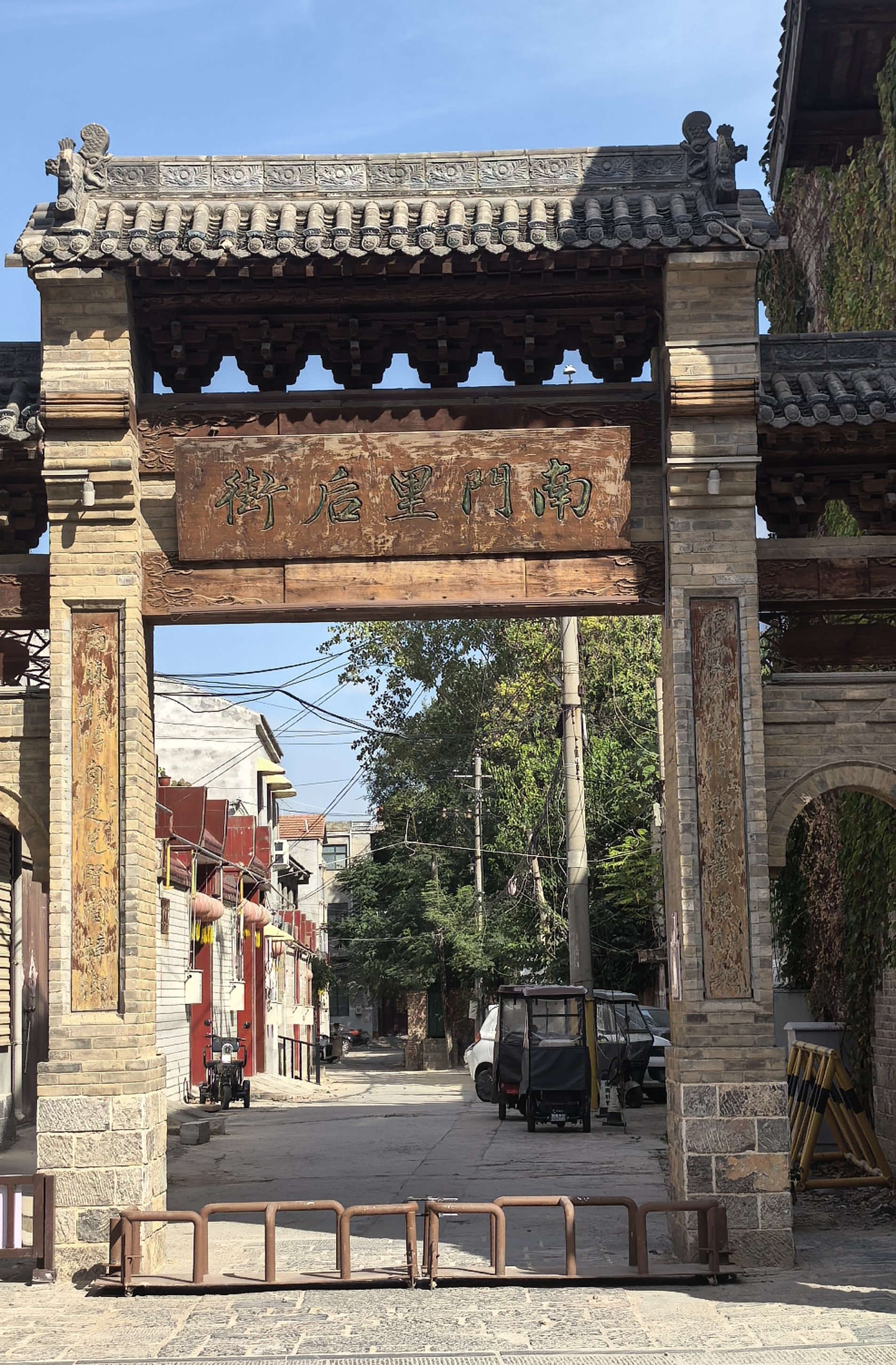
Finally I reached the archway of Nanmenli Street. The wooden plaque reads “Nanmenli Street” in ancient-style characters. On both sides are brick and stone pillars, with couplets carved on them. Passing through the archway, there is a quiet old street, lined with red-brick houses and small shops.
I stood here for a while. The meaning of an archway is never just “marking a place name.” It is a city’s facade and memory. Step forward, and it’s everyday life; look back, and it’s history.
Closing Thoughts
Walking through the ancient city of Xunxian for a day, what moved me most was not the carefully preserved, freshly restored monuments, but the parts still in use — half-worn, carrying traces of life.
The dog by the city wall, the dust on the window lattice, the rust on the wooden door, the grass in the brick cracks — these are “living history.”
Many people may not have heard of Xunxian. But its ancient city, its canal, and its grand temple fair in the first lunar month are genuine national cultural landmarks. It is not loud, but it is quiet enough for you to hear the sound of time.
If you also want to see an ancient city that is still breathing, come walk through Xunxian.